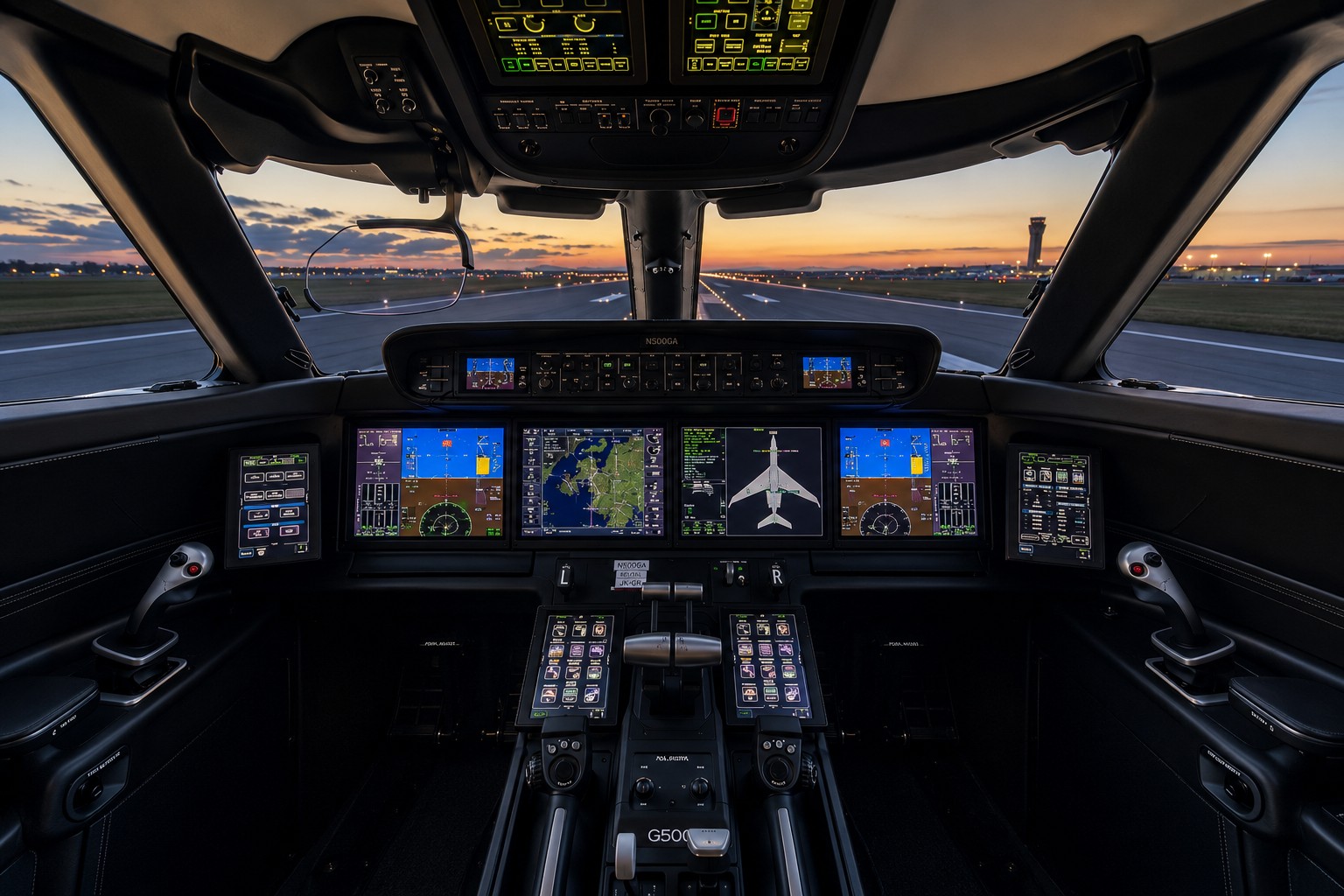
The term avionics generally refers to several systems in an aircraft that allow the pilots to accomplish their primary tasks — to Aviate, Navigate, and Communicate. Avionics in business aviation have come a long way from the first business jets of the 1960s and 1970s, which had mechanical gauges driven by spinning gyroscopes — referred to as steam gauges — for their instruments. Navigation was accomplished with paper charts, manually tuning in ground-based radio stations, and flying outbound and inbound courses between them.
As technology evolved, the old steam gauges were eventually replaced with CRT displays and electronic sensors, and the phrase glass cockpit entered the vocabulary. Today, avionics systems have become highly integrated computers featuring large LCD screens, solid-state accelerometers, and sophisticated electronics that allow the crew to manage complex navigation tasks as well as the monitoring and management of the aircraft’s other systems. Glass panels have become the standard — even for light training aircraft.
With the digital age, new safety systems have been introduced — like ground proximity warning systems and traffic collision avoidance systems — that have saved countless lives.
For owners and prospective buyers, understanding which platform powers your aircraft matters as much as recognizing the OEM brand name on the bezel — the underlying suite drives operating cost, capability, training requirements, and long-term value. With that in mind, we’ll explore the most relevant systems and the recent evolution of technology in the current generation of business aircraft. We’ll explain the technical terms as well as their practical uses and applications.
Common Avionics Components
Modern integrated suites all satisfy the primary flight instrument requirements — airspeed, heading, altitude, vertical speed, turn rate — and manage navigation and communications. The major components shared across every current platform are outlined below.
Core Components — ADC, AHRS/IRS, Nav Radios, GPS/WAAS — Every aircraft carries this set of sensors and receivers, which serve as the information sources feeding the avionics computers. The Air Data Computer (ADC) processes pitot-static inputs into airspeed, altitude, vertical speed, and outside air temperature. The Attitude and Heading Reference System (AHRS) provides solid-state attitude and heading data for the pilots and autopilot; long-range aircraft substitute an Inertial Reference System (IRS) that uses laser ring gyros and can track position independently of GPS or ground-based aids. Two navigation radios receive bearing and distance from ground-based VOR (VHF Omnidirectional Range) and DME (Distance Measuring Equipment) stations. GPS provides satellite-based positioning, almost always augmented by WAAS (Wide Area Augmentation System) for precision-approach accuracy, which enables LPV approaches (Localizer Performance with Vertical guidance) at airports that don’t have a conventional ILS.
Flight Management System (FMS) — The navigation brain of the aircraft. Pilots program in the route, altitudes, and procedures, and the FMS commands the autopilot using combined data from the core components above. It also auto-tunes navigation and communication frequencies as the flight progresses. A well-programmed FMS dramatically reduces crew workload, particularly on long international routes.
Head-Up Display (HUD) — A transparent projection panel that overlays critical flight data — airspeed, altitude, attitude, flight path vector, autopilot mode annunciations — into the pilot’s forward field of view, eliminating the head-down/heads-up cycle on departure and approach. HUDs are typically optional installations on midsize and larger jets and are increasingly common across Primus Epic, Pro Line Fusion, and Garmin G3000/G5000 cockpits.
Enhanced Vision System (EVS) — A nose-mounted infrared camera that displays a real-world thermal image of the terrain and runway environment ahead, allowing pilots to visually acquire the runway in fog, haze, or darkness. EVS imagery is typically presented on the HUD or PFD and is paired with regulatory approvals that permit lower approach minima.
Synthetic Vision System (SVS) — Computer-generated terrain, obstacle, and runway depiction derived from GPS position and an onboard terrain database, presented on the PFD or HUD. Where EVS shows what is actually out there, SVS shows what should be out there — and when the two are fused into one image, the result is called a Combined Vision System (CVS).
Terrain Awareness and Warning System (TAWS) — Combines a terrain and obstacle database with the aircraft’s GPS position and projected flight path to issue visual and aural warnings before the aircraft gets too close to high ground. Honeywell’s branded version, EGPWS (Enhanced Ground Proximity Warning System), is the most widely installed in business aviation. TAWS has been credited with dramatically reducing Controlled Flight Into Terrain accidents — historically one of the deadliest categories in aviation.
Traffic Collision Avoidance System (TCAS) — Interrogates the transponders of nearby aircraft to track their positions and trajectories, then displays the traffic picture on the navigation display. The current standard, TCAS II, can issue Resolution Advisories (RAs) — direct climb or descend instructions to avoid a collision. TCAS II is required on virtually all turbine-powered aircraft operating in controlled airspace.
CPDLC — Controller-Pilot Data Link Communications — A datalink system that lets controllers and pilots exchange text messages instead of (or alongside) voice radio, reducing workload and the readback errors that compound on long routes. Two CPDLC protocols are in use, and modern integrated suites support both:
- FANS-1/A (Future Air Navigation System) — the ICAO-standard datalink used in oceanic and remote airspace, including the North Atlantic, Pacific, and Australian/New Zealand regions. Operationally essential for any aircraft flying international long-haul routes.
- ATN B1 (Link-2000+) — the European-mandated continental datalink, required for IFR operations in much of Europe’s upper airspace. Different protocol, different equipment configuration, but the same operational concept.
For any aircraft expected to operate internationally, dual-protocol capability is a meaningful consideration.
Honeywell
Honeywell’s avionics division has been one of the dominant forces in business aviation for decades, spanning a wide range of aircraft from single-engine turboprops to ultra-long-range jets. Their product line spans three distinct generations of integrated avionics — and a large portion of the active business jet fleet is flying on one of them.
A meaningful number of aircraft still carry the earlier Primus 1000 and Primus 2000 platforms — standard equipment on the Gulfstream GIV and GV, Bombardier Global Express and Global XRS, Embraer Legacy 600, original Dassault Falcon 2000, and Cessna Citation Bravo, Ultra, Encore, X, and Excel/XLS, among others. These are capable, compliant systems, but aging CRT display hardware and discontinued inertial reference units present a maintenance and support challenge that compounds over time — a topic we’ll cover in depth in a separate article on avionics obsolescence.
Primus Apex
For single-engine turboprops and select light jets, Honeywell developed the Primus Apex — a platform that brings the core computing and display architecture of the larger Primus Epic suite down to a size and price point appropriate for smaller aircraft. Apex is currently the standard integrated flight deck on the Pilatus PC-12 NG and PC-24, two of the most capable and widely operated turboprops in business aviation. The system delivers large-format LCD displays, a capable FMS, synthetic vision, and full situational awareness tools — functionality once exclusive to large-cabin jets — in a package suited to single-pilot or short-crew operations.
It’s worth noting that the PC-12 Pro, Pilatus’s latest iteration of its iconic turboprop, moves to Garmin’s new G3000 Prime platform — a shift that reflects the competitive pressure Garmin has placed on traditional avionics suppliers in the turboprop and light jet segment.
Primus Epic
The Primus Epic is Honeywell’s flagship integrated avionics platform for mid-size, large-cabin, and ultra-long-range business jets. It has been in service since the early 2000s and powers some of the most respected flight decks in business aviation — though you may not recognize it by that name. What makes Primus Epic significant is its open, modular architecture: the system is designed to be updated and expanded over time, and it can be deeply customized by aircraft manufacturers to deliver a flight deck that feels entirely their own.
In its more straightforward implementations, Primus Epic appears with four large-format LCDs as the standard flight deck on aircraft like the Cessna Citation Sovereign (680) — a popular super-midsize that flew with Primus Epic for the duration of its production run before the Sovereign+ transitioned to the Garmin G5000.
Several of the most distinctive branded cockpits in the industry are built on Primus Epic:
- Gulfstream PlaneView (G350, G450, G550) — the first commercial application of the platform, widely regarded as the most advanced flight deck of its time at introduction.
- Gulfstream PlaneView II — an enhanced iteration introduced on the G650 with improved displays, processing power, and FANS-1/A+ datalink.
- Gulfstream Symmetry Flight Deck (G500, G600, G700, G800) — retains the Honeywell computing core but redesigns the interface entirely, with ten touchscreen displays and electronically interconnected active control sidesticks.
- Gulfstream Harmony Flight Deck (G300) — newly unveiled in 2025 for Gulfstream’s super-midsize entry that replaces the G280. Built on Honeywell’s next-generation Primus Epic 2 architecture, with six touchscreen displays and Phase-of-Flight intelligence that tailors the cockpit presentation to the current segment of flight.
- Dassault EASy (Enhanced Avionics System) — installed across the Falcon series and evolved through four generations. The current EASy IV on the Falcon 6X and 8X brings touch-enabled controls and significantly improved displays.
Key capabilities of Primus Epic-based platforms include:
- RAAS — Runway Awareness and Advisory System (SmartRunway and SmartLanding): voice and visual alerts for runway incursions, wrong runway selection, unstabilized approaches, and short landing risks
- SmartView: Honeywell’s SVS implementation on primary and navigation displays
- HUD with EVS: Honeywell HUD paired with an infrared EVS camera, standard or optional depending on aircraft
- Electronic Charts and Weather Datalink: integrated Jeppesen chart display and FMS-linked weather overlay
- FANS-1/A and ATN B1 (Link-2000+) datalink: full CPDLC support across oceanic and European continental airspace
- Auto Throttles: integrated thrust management tied to the FMS and autopilot
Collins Aerospace
Collins Aerospace — now a unit of RTX, formerly Rockwell Collins — has arguably the broadest installed base of any avionics supplier in business aviation, with platforms spanning light jets, turboprops, and the largest ultra-long-range aircraft.
The earlier Pro Line 4 platform remains in service on aircraft including the Dassault Falcon 50EX and Falcon 2000, Bombardier Challenger 604, Learjet 60 and 60XR, Astra SPX, Gulfstream G100 and G200, and a range of Hawker and Beechcraft models — a capable system facing the same CRT display and parts availability headwinds as the Primus 1000/2000. These legacy-platform challenges are explored in the forthcoming obsolescence article.
Pro Line 21
The Pro Line 21 platform has been standard equipment on an enormous range of aircraft, including the Bombardier Challenger 300, 350, 605/650, and the recently launched Challenger 3500; the Cessna Citation Encore+, XLS+, and XLS Gen 2; earlier CJ-series Citations; the Hawker 750, 800XP, 850XP, and 900XP; and the King Air 200, 300, and 350 family in production from 2003 onward — earlier King Airs were delivered with Bendix King panels before Beechcraft transitioned the line to Pro Line 21 in October 2003. It is a fully digital integrated avionics suite with LCD displays, a capable FMS, and full support for modern navigation procedures. Collins has continued to develop upgrades — FANS-1/A datalink, ADS-B In, improved displays — keeping it functional and compliant.
Pro Line 21 is sometimes assumed to be a closed chapter for new production, but the Bombardier Challenger 3500 — launched in 2021 and entering service in September 2022 — was delivered with Pro Line 21 Advanced, the same suite carried on the Challenger 350 and 650. Beyond the 3500, the installed fleet is enormous, shop expertise is widespread, and parts are plentiful.
Pro Line Fusion
Pro Line Fusion is Collins’ current-generation platform, advancing the architecture with larger displays, expanded integration, and a significantly more capable feature set. It is the standard avionics suite on Bombardier’s entire current Global series — the Global 5000, 6000, 5500, 6500, 7500, and 8000 — where it powers the Bombardier Vision Flight Deck. It is also standard on the Embraer Legacy 450 and 500, the Praetor 500 and 600, and on the newer King Air 250, 260, 350, and 360 variants.
Pro Line Fusion is also the foundation of the Gulfstream G280‘s flight deck, branded by Gulfstream as PlaneView280 — a Pro Line Fusion-based suite with three 15-inch portrait-orientation displays, cursor-control devices, MultiScan weather radar, and Collins’ optional Head-up Guidance System (HGS). The display layout and graphical treatment differ from a standard Pro Line Fusion cockpit, but the underlying platform is the same.
Key capabilities of Pro Line Fusion include:
- Touchscreen and Cursor Control Interface: pilots can choose between direct touchscreen input or cursor-control devices depending on phase of flight and personal preference
- SVS: Collins SVS implementation across the primary and navigation displays
- IFIS — Integrated Flight Information System: Jeppesen electronic charts, graphical weather, NOTAM data, and airport information all integrated within the avionics suite
- FANS-1/A and ATN B1 datalink: full CPDLC support for oceanic and European continental operations
- Multi-Scan Weather Radar: automatically adjusts radar tilt based on altitude and range to produce a continuous, optimized weather picture without manual adjustment
- Pilot-Selectable Display Format: each of the four primary displays can be independently configured to show different combinations of flight data, synoptic diagrams, charts, and maps — a flexibility that competing platforms don’t offer in the same way
- HGS with EVS / CVS: Collins Head-up Guidance System with EVS option; integrated as the Combined Vision System (CVS) on Bombardier Global variants
- Auto Throttles: integrated thrust management tied to the autopilot and FMS
Garmin
Garmin’s entry into the integrated avionics market has been one of the more consequential developments in business aviation over the past two decades. Starting from a position of strength in the general aviation market, Garmin scaled its platform upward through the turboprop and light jet categories and into Part 25 jets — with a consistent strategy of making glass cockpit capability accessible and the interface intuitive enough to reduce rather than add to pilot workload.
G1000 and G1000 NXi
The G1000 and G1000 NXi are the foundation of Garmin’s business aviation presence. The G1000 — a two-display integrated suite with a Primary Flight Display and Multi-Function Display — became the reference standard for light aircraft avionics. It is standard equipment on aircraft including the Cessna Citation Mustang, the original Embraer Phenom 100 and 300, and a range of turboprops including the Cessna Caravan, Piper Meridian, and Daher TBM series. The G1000 NXi update brought faster processors, sharper graphics, improved connectivity, and over-the-air software update capability.
Garmin has also fielded several successful retrofit programs for older aircraft. The GTN 650/750 TXi navigators, G700 TXi flight displays, and G1000 NXi upgrade packages have found wide adoption in the original Cessna CitationJet and King Air 90, 200, 300, and 350 communities, providing a cost-effective path to WAAS/LPV capability and ADS-B compliance without a full cockpit replacement. In the King Air world, the bulk of these retrofits are going into earlier production aircraft originally equipped with Bendix King panels — though a smaller subset of operators have replaced Pro Line 21 with the G1000 NXi as well, drawn by the weight savings (roughly 250 lbs) and the modern interface. Note that Garmin systems are aftermarket only on the King Air; Collins has been the OEM avionics supplier for the type from the start.
G3000 and G3000 Prime
The G3000 steps up to larger widescreen displays and a pair of touchscreen controllers mounted on the center console — allowing pilots to manage nearly every avionics function without leaving the controls. It is the standard suite on the HondaJet HA-420, the Cirrus Vision Jet SF50, the Daher TBM 960, the Piper M600/SLS, and the Cessna Citation CJ3+ and third-generation CJ4. Embraer brands the G3000 as the Prodigy Touch flight deck on the Phenom 100EV and 300E.
Garmin’s G3000 Prime, introduced in 2025, is the most advanced iteration — featuring three 14-inch multi-touch primary displays alongside two additional touchscreen secondary displays capable of recognizing ten simultaneous inputs. The Pilatus PC-12 Pro became the first aircraft certified with G3000 Prime in March 2025.
G5000 — Part 25 Aircraft
The G5000 is Garmin’s platform for the larger, more complex aircraft certified under FAR Part 25. It uses three 14-inch landscape-format displays and dual touchscreen controllers, scaled for crew-flown jet operations with expanded FMS capability and dual-pilot workflow support. The G5000 is the standard integrated avionics suite across Textron Aviation’s mid-size and super-midsize Citation fleet: the Citation Latitude, Citation Longitude, Citation X+, Citation Sovereign+, and the Citation Ascend — the newest iteration of the 560XL family, which began life with Honeywell Primus 1000 avionics before transitioning to the G5000. The Citation Longitude was the first business jet equipped with the Garmin integrated HUD and Combined Vision System.
Key capabilities across Garmin’s current platforms include:
- SVT (Synthetic Vision Technology): Garmin’s SVS implementation, adding traffic and runway depiction to the primary flight display
- Autonomí Safety Suite: Garmin’s umbrella brand for autonomous safety technologies, including Autoland (autonomous landing if the pilot is incapacitated, activated automatically or by passenger button-press), Emergency Descent Mode (automatic descent and 7700 squawk on pressurization loss), Electronic Stability and Protection (ESP) (keeps the aircraft within safe attitude and airspeed envelopes during hand-flying), and SurfaceWatch (alerts for runway incursions, wrong runway, and inappropriate surface operations). Aircraft makers brand their Autonomí implementations differently — Piper calls it HALO on the M600/SLS and M700, Cirrus calls it Safe Return on the Vision Jet
- GHD 2100 HUD with CVS: integrated Garmin Head-Up Display with a 30-degree field of view; the Combined Vision System fuses EVS and SVT into one image on the PFD and HUD
- ChartView — Jeppesen Charts and Weather: integrated electronic chart display with graphical weather overlay
- FANS-1/A and ATN B1 datalink: full CPDLC support on G5000 for international long-haul operations
- Auto Throttles: integrated thrust management on G3000 and G5000 platforms tied to the autopilot and FMS
A Note for Buyers
The avionics package on a business aircraft is an ecosystem — hardware, software, navigation databases, service bulletins, and the manufacturer that stands behind them. Choosing an aircraft is also a choice of vendor, ecosystem, and the upgrade philosophy you’ll inherit with it.
Operators tend to fall into two camps. Many treat avionics currency as a matter of maintenance policy — every meaningful software update, every optional service bulletin, hardware refreshes whenever the supplier offers a path. Dispatch reliability and maintainability are the priorities, and staying current is treated as a normal operating expense, not something to skimp on.
Others do the minimum required to stay compliant with regulations and mandatory bulletins, and skip the rest. This is more common where ownership is hands-off — the aircraft is run by a management company, and decisions get made on the financial picture rather than the operational one. When the question is whether to spend $250,000 on an upgrade with no obvious operational benefit, the answer is often no.
Both are legal, neither is inherently wrong, but the back-end difference is real. An aircraft kept current is easier to dispatch, easier to maintain, and easier to sell. An aircraft on the minimum-compliance path flies fine today and likely costs less year-to-year, but the bills tend to come due eventually — when a part goes out of production, when a buyer compares it to a current-suite peer, or when an airspace mandate forces a deferred upgrade onto a timeline you didn’t pick. Knowing which path an aircraft has been on is one of the most useful things to establish in a pre-purchase review.